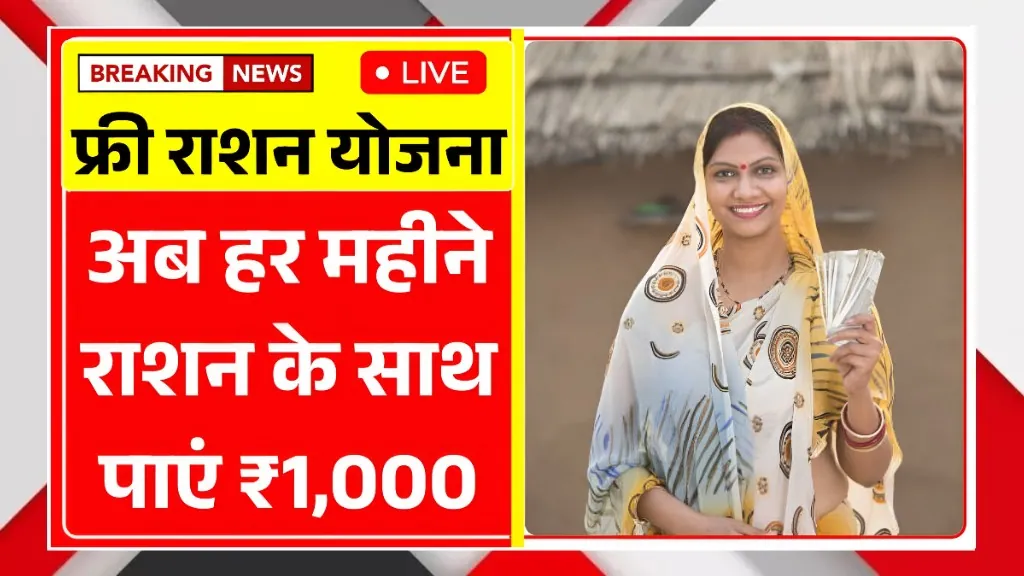

Many people across India are sharing posts claiming that ration card holders will now get free ration plus ₹1,000 every month. As a 24-year-old following government scheme updates, I want to explain this clearly in simple words. At present, the government is providing free food grains under the National Food Security Act, which includes wheat and rice every month. However, there is no official nationwide announcement confirming a fixed ₹1,000 cash benefit with ration. Such claims often come from confusion with state-level schemes or old welfare programs. Always verify news from official government portals or press releases before trusting viral updates.
Highlight Table: Free Ration Scheme & ₹1,000 Claim Overview
| Point | Official Status | Clear Information |
|---|---|---|
| Free Ration Scheme | ✅ Active | Wheat/Rice given monthly under PM Garib Kalyan Anna Yojana |
| Monthly ₹1,000 with Ration | ❌ Not Approved | No central government notification confirms this |
| Scheme Type | Food Security | Focused only on free food grains, not cash |
| Cash Benefit Schemes | ✅ Separate | Given under pensions, DBT, women or farmer schemes |
| Eligibility Check | Mandatory | Depends on scheme rules, income, Aadhaar, bank link |
| Source of Viral News | ⚠️ Misleading | Mostly from social media or mixed scheme information |
| What Beneficiaries Should Do | ✔️ Stay Alert | Trust only official portals and government notices |
This table clearly shows that free ration is real, but ₹1,000 monthly cash with ration is currently a rumor, not an official nationwide scheme.
Reality of Free Ration Scheme in India
The Free Ration Scheme is officially known as the Pradhan Mantri Garib Kalyan Anna Yojana. Under this scheme, eligible ration card holders receive free wheat or rice every month. The main aim is to ensure food security for poor and needy families. The scheme has been extended for several years, making it a strong support system for low-income households. However, this scheme focuses only on food grains, not direct cash transfers. Any news about extra money should always be checked with government notifications.
Where Did the ₹1,000 Claim Come From
The ₹1,000 monthly claim mostly comes from mixing different schemes together. Some states run their own Direct Benefit Transfer programs where money is sent to bank accounts. When people combine these state schemes with free ration news, confusion spreads. Social media exaggerates such information without proof. No central government order currently confirms ₹1,000 every month with ration. Understanding the difference between central and state schemes helps avoid misunderstanding.
Who Actually Gets Cash Benefits
Cash benefits are usually provided under specific schemes like pensions, farmer support, or women welfare programs. These benefits depend on eligibility, income, age, and state policies. Ration card alone does not guarantee monthly cash support. Aadhaar linking, bank account verification, and scheme-specific registration are required. This is why not everyone with a ration card receives money benefits, even if they receive free food grains.
How to Identify Fake Government News
Fake news often uses words like “BREAKING” or “LIVE” to grab attention. It rarely mentions official government websites or notifications. To stay safe, always check news on government portals, PIB releases, or trusted national news platforms. Avoid sharing unverified posts. Correct information helps everyone make better decisions and prevents unnecessary panic or false hope among beneficiaries.
What Ration Card Holders Should Do Now
Ration card holders should continue taking free ration as provided under the government’s official food security schemes. It is important to complete Aadhaar e-KYC, as without it ration benefits can be stopped. Keep your mobile number and bank account linked with Aadhaar updated to avoid future problems. Do not trust social media posts or messages claiming ₹1,000 monthly benefits unless announced on official government websites or through public notices. Never pay money or click unknown links for such schemes. Regularly check updates from your state food department or government portals to stay informed and safe from misinformation.